Beginner to Certified Diver: Diving Course in Bali
Many people stare at the ocean and wonder what it feels like to breathe beneath the surface. If you are ready to find out, follow the journey from your first breath underwater to becoming a certified diver with practical tips for Diving Course in Bali. The beginner-to-certified-diver journey is a profound personal transformation that goes far beyond simply memorizing equipment rules. When you begin researching diving courses in Bali, it helps to understand exactly what this process entails, both physically and mentally, as you transition from a curious observer to a capable underwater explorer.
The Reality of Your First Breath Underwater
The moment you put a regulator in your mouth and submerge your face is entirely unnatural to the human brain. Your terrestrial instincts will likely tell you to hold your breath or stand up immediately. For anyone starting beginner diving Bali, the first few minutes in shallow water are purely about overriding these reflexes.
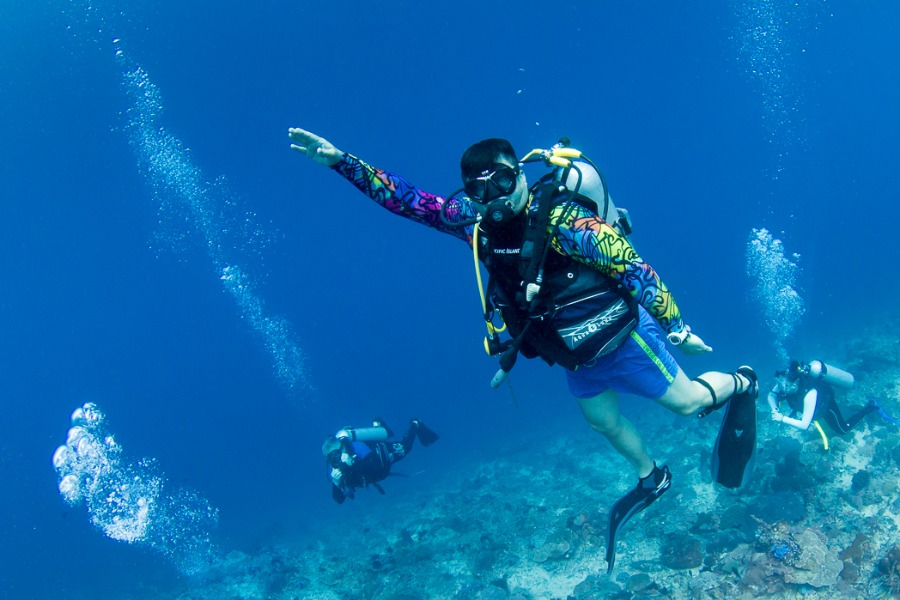
Breathing compressed air sounds loud. The inhalation is distinct, and the exhalation produces a stream of bubbles that rush past your ears. It is completely normal for your initial breathing rate to be faster and shallower than usual. The immediate goal is not to swim or look at fish, but simply to kneel in shallow water, listen to the rhythm of your own breath, and realize that the equipment is reliably delivering air. Slowly, the nervous energy settles, and you learn to trust the regulator.
Finding Comfort and Balance Below the Surface
Once breathing begins to feel deliberate, your focus will naturally shift to how your body occupies space in the water. Scuba diving requires a complete recalibration of movement. On land, gravity dictates our posture; underwater, we must learn to manage buoyancy and drag.
During your early scuba diving lessons Bali, you will realize how heavy the tank feels on the surface and how remarkably weightless it becomes underwater. Comfort develops as you start to recognize how your lungs act as natural buoyancy devices. You will practice hovering, finding a horizontal trim, and learning to kick from your hips rather than cycling your legs like a bicyclist. Getting comfortable matters immensely because physical relaxation directly impacts your air consumption and mental clarity. A relaxed diver uses less air and processes their surroundings more effectively.
Transforming Beginner Nervousness Into Genuine Confidence
Learning to dive is a heavily psychological process. Many students experience a baseline level of anxiety when facing a new environment, especially one where humans are not naturally equipped to survive.
Transitioning from a nervous student to a capable diver requires repetition and guided exposure. A reputable Bali dive school will not rush this critical phase. Your instructor will demonstrate a skill, have you repeat it, and then repeat it again until muscle memory takes over. True underwater confidence does not come from false bravado or ignoring risks; it comes from competence. Knowing exactly how to handle a flooded mask or a misplaced regulator replaces fear with a concrete, actionable plan.
Mastering the Practical Skills of Scuba Diving
The foundation of an Open Water Diver Bali certification rests on practical, standardized skills designed for self-sufficiency and buddy safety. These are not just boxes to tick on a training slate; they are the tools that keep you calm when unexpected situations arise.
Buoyancy Control
This is arguably the most critical skill a diver learns. Mastering your inflator hose and lung volume prevents you from crashing into fragile corals or floating uncontrolled to the surface. Good buoyancy protects both you and the marine environment.
Mask Clearing and Regulator Recovery
Water will inevitably enter your mask at some point. Learning to gently exhale through your nose while tilting your head back to clear the water ensures a minor leak never turns into a panicked ascent. Similarly, if your primary air source is accidentally knocked out of your mouth, you will learn how to locate it quickly and clear it of water using either a forceful exhalation or the purge button.
Underwater Communication
Since talking is impossible, you will learn a vocabulary of standardized hand signals to communicate air supply levels, directional changes, and any physical discomfort to your buddy and instructor.
Leaving the Pool: Transitioning to the Open Ocean
Pools and shallow, protected bays are predictable. The ocean is not. Transitioning to open water introduces variables that no confined training session can fully replicate.
When you take a scuba diving course Bali, moving to the ocean means encountering natural currents, changing visibility, varying water temperatures, and uneven underwater terrain. It also introduces marine life. This phase of learning is about applying your controlled skills in a dynamic environment. Your instructor will guide you on how to enter the water through gentle surf, how to descend while equalizing your ear pressure, and how to maintain situational awareness when the environment is vast and visually overwhelming.
The Experience of Your First Open Water Dive
The first official open-water descent is a milestone. Initially, your attention will be entirely inward—monitoring your breathing, checking your air pressure gauge, adjusting your buoyancy compensator, and keeping your eyes firmly locked on your instructor.
Then, usually about halfway through the dive, a shift occurs. Your buoyancy stabilizes, your breathing slows, and you look up. You might notice a sea turtle gliding past, the intricate structure of a coral reef, or a school of colorful fish shifting in unison. This is the exact moment the mechanical skills fade into the background, and the practical application of your training takes over. It is the hard-earned reward for the hours of drills and theory.
When the Underwater World Starts to Feel Natural
Gaining your Bali diving certification is an achievement, but the true feeling of natural comfort often arrives a few dives later. This stage is marked by a distinct decrease in conscious effort. You no longer have to remind yourself to equalize; you do it instinctively as you descend. You stop using your hands to balance and rely solely on your breathing and steady fin kicks.
With this newfound comfort comes a heightened awareness of the environment. You become better at spotting macro life, understanding current directions, and anticipating your buddy’s movements. However, a responsible diver knows that comfort should never evolve into carelessness. Standard safety checks, dive planning, and situational awareness remain fundamental, regardless of how relaxed you feel.
Life After Your Bali Diving Certification
Certification is the beginning of your education, not the finish line. Earning an entry-level card proves you can dive safely in conditions similar to your training, but the ocean offers environments that require specialized knowledge.
Many divers choose to continue their progression to build targeted skills. This might mean enrolling in an advanced diving course Bali to safely experience deeper limits and nighttime conditions, or taking specialty courses focused on perfect buoyancy, nitrox gas blending, or deep-water navigation. The goal is to gradually expand your comfort zone under the supervision of a professional, rather than attempting difficult dives through trial and error.
Why Diving Courses in Bali Shape Better Divers
Bali provides a marine environment that serves as an exceptional classroom. Because the island is positioned between the Indian and Pacific Oceans, it offers an incredible variety of underwater topographies and marine habitats.
Choosing to learn to dive in Bali means you might practice foundational skills over calm, sandy slopes before eventually observing vibrant coral walls or managing gentle drift dives as your experience grows. However, not all dive sites around the island are meant for beginners. Completing your training with a professional operation like NusaBlu ensures you are guided to locations that precisely match your current skill level. A responsible dive center prioritizes your long-term development, placing you in environments that challenge you constructively while maintaining strict safety margins.
Continuing Your Underwater Education
The transition from a hesitant beginner to a certified diver is a rewarding progression of both physical skill and mental resilience. Taking diving courses in Bali means immersing yourself in one of the most biodiverse marine environments in the world, where every logged dive teaches you something new about the ocean and your own capabilities. Earning a certification is just the first step in a lifelong journey of developing better buoyancy control, refined safety habits, and a deeper respect for marine ecosystems. If you are ready to take that first breath underwater and build a strong foundation for your future dives, explore professional training and guided experiences with NusaBlu.
Frequently Asked Questions
What does learning to dive in Bali feel like for a complete beginner?
Initially, it feels sensory-heavy and physically unfamiliar. You are wearing heavy gear and breathing through your mouth. However, as you practice in shallow water, the weightlessness takes over, and the experience quickly shifts from awkward to incredibly liberating.
Is it normal to feel nervous during your first dive?
Yes, feeling nervous is a standard human reaction to breathing underwater for the first time. Instructors expect this and are trained to pace the sessions slowly, ensuring you build trust in your equipment and your own abilities before moving to deeper water.
What scuba diving skills should beginners focus on first?
Before worrying about swimming efficiently, beginners should focus entirely on slow, controlled breathing and basic buoyancy. Once your breathing is calm and you can maintain a neutral position in the water, everything else becomes significantly easier.
When does diving usually start to feel more comfortable?
For most students, a noticeable shift happens during the second or third open-water dive. This is when muscle memory begins to handle equipment management, allowing your brain to focus on observing the marine environment rather than over-analyzing every physical movement.
What happens after completing an Open Water certification?
You are certified to dive globally to a maximum depth of 18 meters alongside a buddy. From there, you can choose to log recreational dives to build personal experience or enroll in further education to learn deep diving, underwater navigation, or rescue techniques.
Does becoming certified mean I am ready for every type of dive?
No. An entry-level certification means you are trained for conditions similar to where you learned. Diving in strong currents, cold water, overhead environments, or deep sites requires additional training, progressive experience, and an honest assessment of your personal limits.