
Best Time to Dive in Nusa Penida: The Complete Guide 2026!
When planning a dive trip to Bali, one question often comes up: when is the best time to dive in Nusa Penida? In fact, you can dive in Nusa Penida all year round. However, each season offers you a different marine experience.
Are you hoping to spot a Mola Mola, swim alongside a manta ray, or try open water diving for the first time? Choosing the right time will make a big difference.
This guide walks you through the Nusa Penida diving seasons, so you can plan a better trip.
Is Diving in Nusa Penida Worth It All Year Round?
Absolutely!
This is one of the reasons Nusa Penida stands out from other diving destinations in Southeast Asia. The island sits within the Coral Triangle, and the Indonesian Throughflow Current nourishes its waters, supporting rich marine biodiversity and healthy coral reefs.
Still, you should understand two main seasons. First, the dry season (April to October) usually brings calmer waters. Visibility clearly improves to between 20 and 30 meters, with more predictable conditions.
Meanwhile, the rainy season (November to March) tends to bring afternoon rain along with stronger currents. Consequently, fewer visitors come during this season, so prices stay affordable. Surprisingly, manta rays actually become more active during this period.
Read More: Try PADI Open Water Course with Nusablu
Nusa Penida Dive Conditions
| Month | Conditions | Marine Biota Highlights | Suitable for |
| January–February | Afternoon rain, currents vary | Manta rays are very active | Experienced divers |
| March–April | Transition, conditions improve quickly | Increased visibility, mantas present | All levels |
| May–June | Full dry season | Clear water, all marine life | All levels |
| July–August | Peak season | Mola Mola sightings, manta rays | Advanced diver |
| September–October | Peak Mola Mola season | Highest viewing rate | Advanced diver |
| November–December | Transition to the rainy season | Quieter, lower prices | Privacy seeker & budget |
Best Time for Nusa Penida Diving
a. April & May – Best Time for All Levels of Divers
If you’re reading this while planning a trip in the near future, this timing works well. April and May mark the transition into the full dry season.
During this period, visibility starts reaching its best levels, and currents become easier to predict than during the rainy season. In addition, dive sites are usually less crowded than in July and August.
You can spot manta rays consistently at Manta Point and Manta Bay throughout this period. For beginner divers, therefore, this month offers the most comfortable conditions. You can also try drift diving in clear water alongside calm marine life.
If you’re completing a PADI Open Water course or planning to take one, April and May give you a great window to enjoy the underwater world of Nusa Penida.
At Nusablu, our PADI-certified instructors open fun dive slots and beginner courses every day. As a result, you can adjust the schedule to fit your own conditions and experience level.
b. June & July – Dry Season Is in Full Swing
Once June arrives, dive conditions in Nusa Penida reach a clear peak. Visibility often reaches 25 to 30 meters, which makes Crystal Bay and Toyapakeh especially beautiful.
From late June through July, you can also spot Mola-Mola fish. As cold water rises from the Indian Ocean through upwelling, it draws sunfish toward the cleaning stations in shallower depths.
Currents also grow stronger at some sites during this time, which in turn attracts larger pelagic species. Therefore, we increasingly recommend an Advanced Open Water certification for diving at Crystal Bay and Blue Corner. Overall, if you plan a dive in Nusa Penida specifically to watch sunfish, June is the right time.
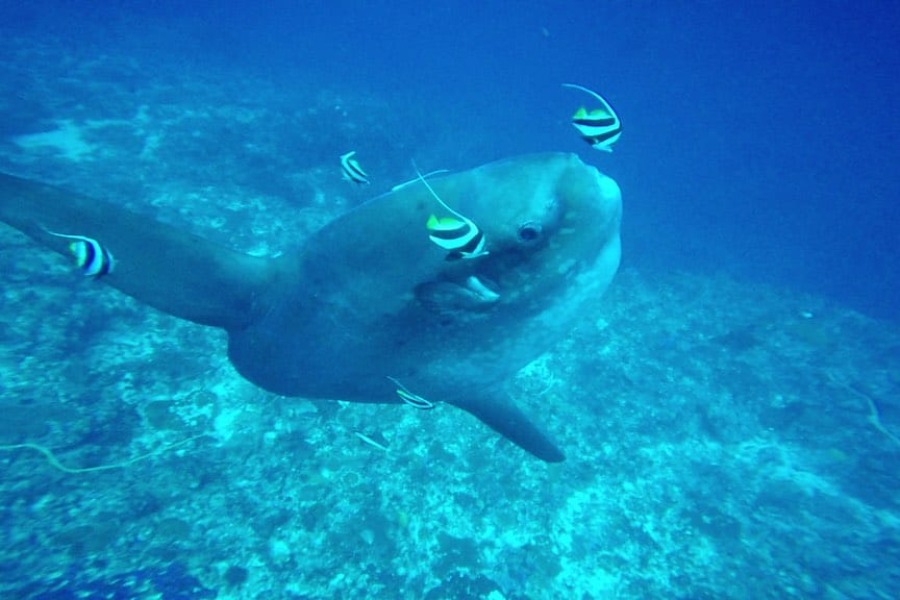
c. August & September – Peak Mola Mola Season
The world’s diving community often seeks out this season. August and September mark the peak of Nusa Penida’s Mola Mola season, and meeting this extraordinary wildlife stands out as a major highlight.
During these months, seasonal upwelling from the Indian Ocean drops water temperatures to between 13 and 17°C in some parts of the island. As a result, cold, nutrient-rich water draws sunfish – the world’s largest bony fish – up from the depths toward the cleaning stations. Crystal Bay remains the most famous cleaning station location.
Before diving this season, prepare accordingly: bring a 5mm wetsuit (a hood helps too), hold an Advanced Open Water certification for deeper sites, and set realistic expectations, since Mola Mola sightings are exceptional but never guaranteed.
d. October & November — Quieter Crowds, Still Satisfying
Mola Mola sightings begin to decrease in October as water temperatures rise again, though early October still offers fairly good opportunities. Once November arrives, the transition back to the rainy season begins, and the character of the Nusa Penida diving experience starts to shift.
Crowds usually thin out a little, since day-trip boats from Bali operate less frequently. Prices at resorts and dive centers also drop. Therefore, for divers who want a more personal experience and aren’t in a hurry, November offers a wonderfully underrated time to visit.
At Nusablu, we offer more private diving options from November to February, ideal for couples or small groups seeking an exclusive experience.
e. December to February – The Thrill of Diving During the Rainy Season
The rainy season in Nusa Penida differs from what most people imagine. Rain typically falls only in the afternoon and evening, so morning dives remain largely unaffected. The real change actually happens underwater: visibility drops slightly to about 15 to 20 meters in some conditions, but rising nutrient levels encourage very active manta ray behavior.
This season also demands more flexibility, since operators select dive sites daily based on wave and current reports. Consequently, having an experienced local team, such as the instructors at Nusablu, becomes invaluable during this period.
Choosing the Best Time Based on Your Goals
Here are some pointers from Nusablu to make your diving experience in Nusa Penida more valuable.
- Want to see Mola Mola? → Choose August–September, and consider our Advanced Open Water package for the best experience.
- Want to see Manta Ray? → You can spot manta rays year-round, though April–October offers the best months at Manta Point.
- Diving for the first time or taking a course? → We recommend April–June, since these months offer the friendliest water conditions.
- Best visibility? → Dive in Nusa Penida between June and August, when water visibility reaches up to 30 meters.
- Want the quietest season? → Choose November–February if you want a more private experience with your partner or family.
- Private or exclusive diving? → November–February offers the best experience, especially if you book early.
Why Choose Nusablu for a Diving Experience in Nusa Penida?
Nusablu offers more than just a dive center in Nusa Penida. We also provide a complete experience through our luxury resort and PADI-certified dive center, located in the Kutampi Kaler Hill area – home to some of the island’s best views.
After exploring the underwater beauty, from pristine coral reefs to graceful manta rays swimming through their habitat, you won’t need to endure a tiring boat trip back. Instead, you can simply return to our resort, relax, and enjoy a stunning sunset panorama from the hilltop.
Our experienced, PADI-certified instructors professionally manage every diving experience at Nusablu. We carefully select the best dive spots around Nusa Penida, so every dive feels safe, comfortable, and unforgettable.
Frequently Asked Questions (FAQ)
When is the best time to dive in Nusa Penida?
Dive during the dry season, from April to October, since it offers the best overall conditions. The Mola Mola season peaks in August and September.
Can beginners dive in Nusa Penida during the rainy season?
Yes, with the right operator. Beginner-friendly sites remain accessible during the rainy season, and experienced instructors carefully choose conditions for safety.
Can you see Mola Mola all year round in Nusa Penida?
You can spot Mola Mola in the area throughout the year. However, they rise to reachable cleaning-station depths especially between July and October.
What kind of wetsuit do I need for diving in Nusa Penida?
A 3mm wetsuit works well during the warm months. During the Mola Mola season (July to October), we highly recommend a 5mm wetsuit, since water temperature can drop to 13–17°C at depth.
How many dives can I do per day at Nusablu?
Our standard fun dive package includes two dives per day. We also offer additional and private diving options, so contact us directly to plan an itinerary that suits your needs.
Ready to plan a diving trip to Nusa Penida? Contact Nusablu or explore our diving packages to find an experience that suits your level and time of visit.