
Can Beginners Dive in Nusa Penida? The Comprehensive Guide!
Nusa Penida has grown rapidly to become the most iconic diving destination from around the world. Many people consider that Kelingking Beach and Manta rays are symbols of natural beauty in Nusa Penida.
Some diving communities say that Nusa Penida Island is known for its wild currents, deep sea walls, and legendary sunfish. This reputation has sparked a common question from divers: Can beginners dive in Nusa Penida?
The answer is Yes, Absolutely! But, diving in the high seas of Nusa Penida is different from diving in a swimming pool. Dive in Nusa Penida for beginners needs to get a specific approach, professional guidance, and more understanding.
This guide will discuss what there is to know for a scuva diving trip on the island.
Nusa Penida Diving Is Not Only For Experts
There is a misconception that says that diving in Nusa Penida is only for Advanced divers only. It is true, but only in some locations such as Blue Corner that have stronger currents. In fact, Nusa Penida is a large island with a diverse underwater topography.
Nusa Penida is located in the Lombok Strait with the main channel for Indonesian Throughflow. The movement of large water masses from the Pacific Ocean to the Indian Ocean makes the current move fast and attracts large fish.
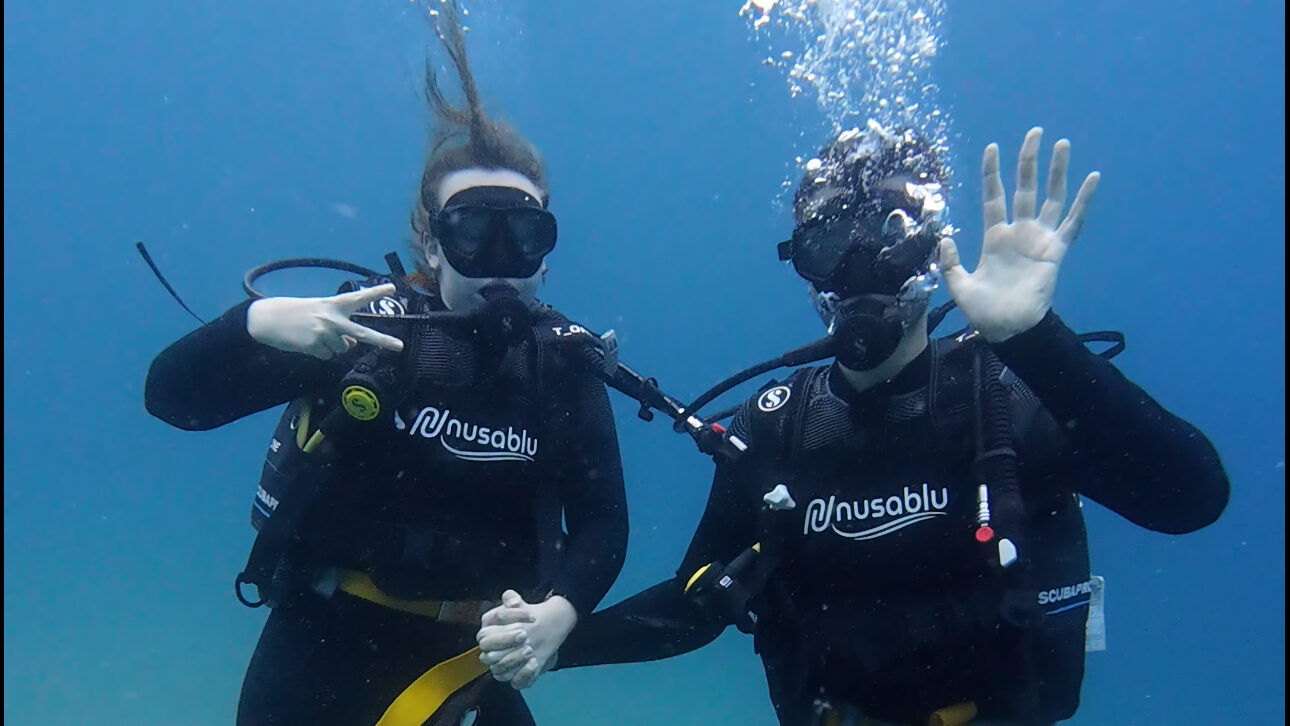
For a beginner, it may sound daunting. However, professional dive centers in Nusa Penida such as Nusablu are reliable and have local knowledge in predicting when and where to locate with soothing waters. Understand the flow that makes Nusa Penida beginners diving very safe.
Read More: 7 Criteria for Choosing a Diving Center in Nusa Penida
Diving Program Options for Beginners
If you are a beginner diver, you can choose one of the following two categories.
a. Program Discover Scuba Diving (DSD)
This program is often referred to as “Try Dive” which is designed for those who have never breathed underwater and are not ready to do a full certification course.
- The process: You will begin a briefing on the ground on how basic hand equipment and signals work.
- Skills: Training on 3 or 4 basic skills in shallow water.
- Dive: Perform live dives at Manta Point and Crystal Bay with an instructor holding your hand. The maximum depth ranges from 12 meters.
- For whom: Suitable for tourists who only have one day vacation and want to see the underwater ecosystem without learning a long theory.
b. PADI Open Water Course
This course has the standard to become a certified diver. If you want to try diving in Nusa Penida or other locations independently, then this is the starting point.
- Theory: You complete the e-learning module before arriving at the Location.
- Exercise in calm water: You can spend time in a pool with calm water while learning to clean your mask, pick up regulators, and manage buoyancy.
- Do an open sea dive: You can complete four dives over two days in the open sea of Nusa Penida.
- Results: Earned lifetime certification related to diving with depths of up to 18 meters.
Best Dive Locations for Beginners in Nusa Penida
One of the reasons why Nusa Penida is suitable for beginner diving is the diverse location. 3 locations suitable for divers:
- Manta Point
Manta point is located on the southern cliff of Nusa Penida and is a cleaning station. Usually, many giant manta rays gather here so that they can be cleaned of parasites by small fish.
- The depth becomes 5 to 12 meters (very shallow).
- There is rarely a current and there can be a surge.
- This location is one of several locations that are suitable for beginner divers and can see stingrays with a width of 4 meters.
- Crystal Bay
Crystal Bay has the best visibility and reaches 40 meters with its water clarity. Although the bay is deep and prone to currents, the interior has protection from calm sand.
- The depth is about 5 to 15 meters.
- The current conditions are quite calm with clear waters.
- This location can make you feel like swimming in a giant aquarium. Divers can see school fish Anthias, clownfish, and green turtles resting on the reef.
- North Coast (SD, Pura Ped, and Sental)
The beach in the North of Nusa Penida has a long coral reef and a perfect location for drift diving or diving with the current.
- How It Works: The diver will jump into the water, set the power to the point, and let the body follow the gentle flow of currents that carry it down the coral reef. The boat will follow the bubble and pick you up wherever you appear on the surface.
- Why beginners love it: Meat movement finning (kicking) doesn’t need to do much. This will be a Nusa Penida diving experience full of relaxation.
The Sea Life of Nusa Penida That Can Be Found
You won’t dive too deep to see a large swarm of fish. Most of the marine life can be seen from a depth of 12 meters. Marine life in the waters of Nusa Penida:
- Manta rays: Fish that settle all year round and often glide near divers.
- Sea Turtles: Green turtles or hawksbill turtles that are seen chewing on sponges or sleeping under coral crevices.
- Nudibranch: For lovers of small creatures, neon sea snails come in beautiful colors.
- Reef Shark: Reef sharks with white tips and black tips are known to be predatory animals and harmless to humans.
- Macro biota: From ornate Ghost Piperfish to frogfish will be seen with the biodiversity that is the dream of underwater photographers.
Why Choose the Right Dive Center in Nusa Penida?
If you are looking for information about Nusa Penida Diving, then you will find many options. Here’s what a professional dive center like Nusablu provides:
- Professional Briefing: A good briefing should include about the topography of the location, potential water conditions, how to signal, and procedures for Returning to the boat.
- Equipment Maintenance: Bali has high salt levels so the equipment wears out quickly. Nusablu has done a structured schedule of diving equipment. Starting from maintenance for regulators and BCDs so that they can hold air perfectly.
- Emergency Oxygen and P3K: Each boat must be equipped with additional equipment. Although accidents will be rare, readiness is part of professionalism.
Beginners Dive in Nusa Penida Responsibly
As a beginner diver, you have a unique opportunity for a diving career with a good mindset. Nusa Penida coral reefs are part of the MPAs (Marine Conservation Areas).
- Buoyancy is key: The most common way for beginners without damaging coral reefs by accidentally kicking. The instructor will help the diver master the power of the diver so that he can float without weight.
- See and don’t touch: Touching manta rays can remove their protective mucus layer and make them quickly infected.
- Garbage awareness: If you see plastic garbage in the water, then don’t hesitate to pick it up. Every small contribution will go a long way.
Why Choose Nusablu for a Dive Experience in Nusa Penida?
Nusablu sells diver trips that make divers want to do it repeatedly. We understand that your first dive will be a historic moment in life.
- Patience: We move along with the flow of the diver. If the diver needs 10 minutes to be on the surface, then the instructor is ready to accompany you.
- Membership: Our guides live and breathe in these waters. So, they know every gap in the coral reef.
- Small groups: We guarantee your experience will be personalized where you won’t be diving in a large group.
Frequently Asked Questions (FAQ)
Is Nusa Penida only suitable for professional and advanced divers?
No, it is a misconception that Nusa Penida is only for experts. While certain spots like Blue Corner have intense currents, the island features a highly diverse underwater topography with plenty of calm, shallow spots perfectly suited for beginners.
What diving programs are available in Nusa Penida for people with no prior experience?
Beginners can choose the Discover Scuba Diving (DSD) program, also known as a “Try Dive,” which offers a quick briefing and basic skill practice followed by a shallow guided dive up to 12 meters. Alternatively, they can take the full PADI Open Water Course to earn a lifetime certification allowing them to dive independently up to 18 meters.
Which specific dive locations in Nusa Penida are best for beginner divers?
Manta Point offers shallow depths of 5 to 12 meters with minimal current, making it ideal for seeing giant manta rays. Crystal Bay features a protected sandy interior with calm waters and excellent visibility, while the North Coast sites like SD, Pura Ped, and Sental provide a relaxed environment for gentle drift diving.
What kind of marine life can beginners expect to see at shallower depths?
At depths of around 12 meters, divers can easily encounter resident manta rays, resting green or hawksbill sea turtles, colorful nudibranchs, harmless white-tip and black-tip reef sharks, and diverse macro biota like frogfish and ghost pipefish.
How can beginner divers practice responsible diving to protect Nusa Penida’s coral reefs?
Beginners should focus on mastering their buoyancy to avoid accidentally kicking or damaging the coral, strictly follow the “see and don’t touch” rule to protect marine life like manta rays from infections, and actively participate in garbage awareness by picking up any drifting plastic waste.